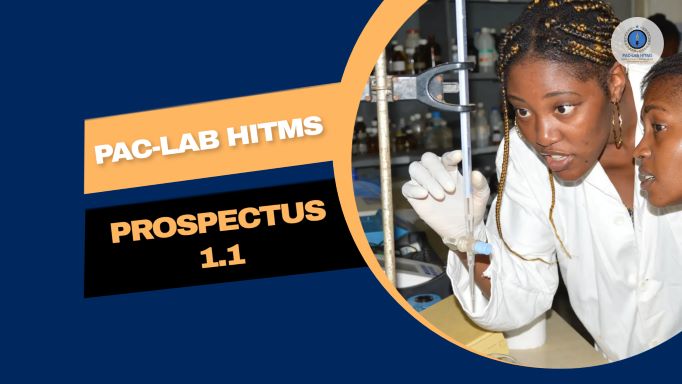
Download our prospectus to get a synoptic view of the programs we offer.
Download ProspectusThe planet needs problem solvers! Our programs are delivered with a global training focus to help you face the challenges affecting today’s society. Practical and field trips are at the heart of programs offered at PAC-LAB HITMS. The real world is the most important classroom, thus going beyond the classroom helps you apply your learning to real-life scenarios and understanding how the world works. These are great opportunities to get your hands dirty!
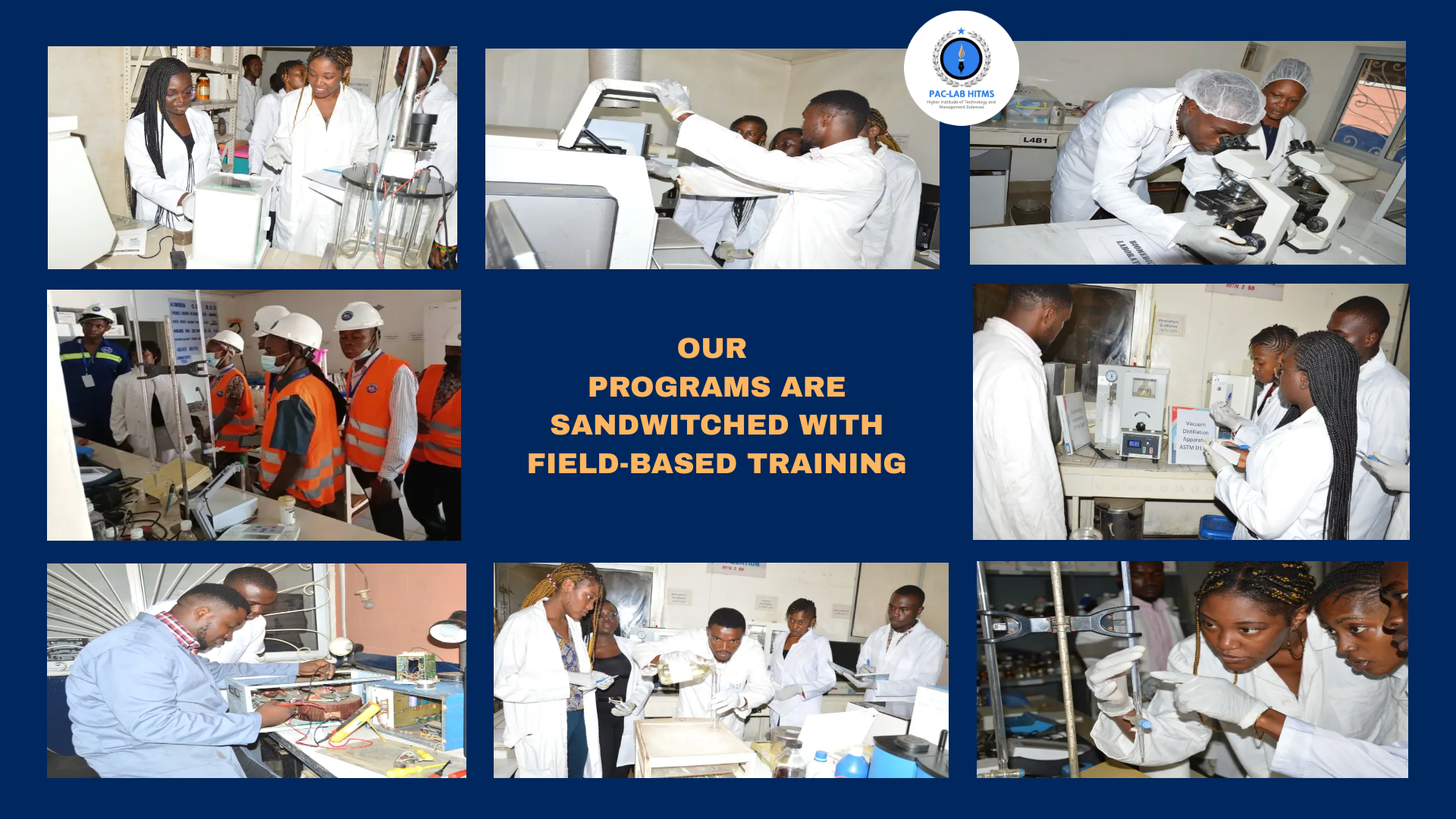
All undergraduate and graduate programs are grounded in the study of human development, Technological learning, science and theory. Faculty and students engage in high-quality and equity-oriented research, program evaluation, and professional learning that impacts local, regional, national, and global communities.
The Higher National Diploma (HND) is a fast-track qualification aimed at preparing students for a particular job or career. It is available in all kinds of specialties, from HND in Business Management to HND in Engineering & Technology to HND in Arts, Culture, and Education and HND in Medical and Biomedical Sciences. HND courses are valued globally by universities, employers, and companies and are an excellent route for those who wish to have a more hands-on experience in their studies.
The Higher National Diploma saw the light of day in 1920 in England and Wales and was progressively adopted by all Commonwealth nations. It was not until 20 years ago when in 2002, that the HND was introduced in Cameroon by Ministerial Order No. 02/0069/MINESUP/DDES as a recognised higher education exam.
The duration of the HND is generally a two-year, four-semester program for the majority of the programs, except for Medical and Biomedical programs, which are three years and six semesters.
At PAC-LAB HITMS, we offer flexibility in your program by making the completion of an HND dependent on the individual without any extra cost. So, if you have other engagements, you can opt to enroll for an HND on a part-time basis. This means you will still have time for other things and your fee will be spread for your duration of study amounting to the same cost as a full time student.
The Higher Nation Diploma (HND) is 120 credits, which is approximately two-thirds of a three year standard-length undergraduate degree and half a standard four years undergraduate degree.
Although there are different entry requirements adopted by different countries, in Cameroon the main entry requirement for an HND program is at least two Advanced level, Baccalaureate and a range of international qualifications judged by the ministry of secondary education as equivalent to an “A” level or BACC.
An HND is suitable for all manner of people. In Cameroon, there is no age limit for enrolling and writing an HND. So any one with the minimum entry requirement can certainly achieve an HND. Besides, if you have a career in mind, an HND can generally offer a more direct route into that industry, this is because an HND is great for those who love to learn through practice.
Since the HND is an internationally recognized and valued academic qualification with a more professional emphasis, there is just so much one can do with an HND from Starting your own business, Seeking discipline specific full time job/employment and Enrolling for a top-up/full-fledged bachelor’s degree or professional qualifications. This is becoming a very popular option for many graduates to top-up their HND into degrees
An HND remains a great way to explore and build knowledge focused around a chosen discipline while gaining invaluable vocational skills.
HND exams are conducted officially by the Ministry of Higher Education in Cameroon. Students studying under various higher institutions write common exams in specific writing centres nationwide. Exams are set per discipline with common (transversal courses) cutting across all specialities. The marking, compiling and publishing of results are done exclusively by the ministry of Higher Education (MINESUP) Cameroon. HND exam in Cameroon are organized in the following phases:
Grades are: pass, credit, and distinction. Students who fail a course or more are generally not declared successfully and thus required to reseat the courses failed rather than the entire exam in the next session. So a pass in all courses is important to be declared successful.
Students can generally register for an HND either as internal candidates (under a recognized and authorized higher institution of learning) or as external candidates directly at the Ministry of Higher Education in Yaounde.
At PAC-LAB Higher Institute of Technology and Management Sciences the programs offered have been grouped into seven schools listed below.
Courses taught at PAC-LAB HITMS have been developed with the assistance and guidance of a dynamic teaching team, employers, consultants, discipline and industry experts who work in synergy to ensure that course content and delivery stays relevant and covers industry demands.
A Bachelor’s Degree is an undergraduate academic qualification awarded by a college or university after completing a structured program of higher education, usually lasting about three to four years of full-time study, though in some countries it can extend up to six years depending on the field and system. It provides both broad general education and specialized study in a particular subject (called a major), and is often the minimum requirement for many professional jobs and for further study, such as master’s or doctoral degrees.
MAIN FEATURES
It is classified as the highest level of undergraduate degree, normally above a certificate, diploma, or associate degree but below postgraduate degrees like master’s and doctorate.
Typical program length is three to four years (about 180-240 credit hours in systems that use credits), though some professional or technical fields may take longer.
TYPES OF BACHELOR'S DEGREE
Common types include Bachelor of Arts (BA), focusing more on humanities and social sciences, and Bachelor of Science (BSc/BS), focusing more on scientific and technical disciplines.
Many specialised variants exist, such as Bachelor of Engineering (BEng) or Bachelor of Technology (BTech), Bachelor of Fine Arts (BFA), and others tailored to particular professions or sectors.
The duration of those seeking direct entry for a full-fledged BACHELOR DEGREE (BSc) without the HND route is generally a three-year, six-semester program for the Management and Business programs and a four-year, eight-semester program for the Engineering & Technology/Medical and Biomedical Sciences programs. The duration of those seeking a BACHELOR'S DEGREE (BSc) with the HND route has an additional one year each to obtain a BTECH for those in Engineering & Technology, which is one year and two semesters, and one year to obtain a BSC for those in Medical and Biomedical Sciences, which is one year and two semesters.
At PAC-LAB HITMS, we offer flexibility in your program by making the completion of a BACHELOR'S DEGREE dependent on the individual without any extra cost. So, if you have other engagements, you can opt to enrol for an HND on a part-time basis. This means you will still have time for other things, and your fee will be spread out for your duration of study, amounting to the same cost as a full-time student.
The BACHELOR'S DEGREE (BTECH/BSC) is 180-240 credits hours, which is approximately three to four years, though some professional or technical fields may take longer.
Although there are different entry requirements adopted by different countries, in Cameroon, the main entry requirement for a Bachelor of Technology (BTech) program is a pass in HND or being a holder of an HND. Those seeking direct entry for a full-fledged Bachelor’s degree (BSc) without the HND route have at least a pass of 2 A-level and 4 O-level papers and a range of international qualifications judged by the Ministry of Secondary Education as equivalent to an “O” level, “A” level, or Probatoire BACC. However, specialty/school-specific requirements apply. For more info, see schools and departments.
A bachelor’s degree is suitable for all manner of people. A bachelor’s degree is designed for people who want a first full university qualification that prepares them for professional work or further study after secondary school. In Cameroon, there is no age limit for enrolling on a bachelor’s degree program. So anyone with the minimum entry requirement can certainly achieve a bachelor’s degree.
PURPOSE FOR LEARNERS
Those seeking entry into professions where a bachelor’s is the standard minimum qualification (for example, many technical, business, and public‑sector roles).
Those intending to progress to postgraduate study (master’s, professional degrees, or PhD) and needing a recognised undergraduate foundation.
Since a BACHELOR'S DEGREE is an internationally recognized and valued academic qualification, a bachelor’s degree can help you qualify for a wide range of jobs, open doors to higher degrees, and strengthen your chances for promotion and leadership roles. What you can do exactly depends on your field of study, your grades, and the skills and experience you build while studying.
Further study and specialization with a bachelor’s degree you can:
Apply for master’s degrees, professional postgraduate diplomas, and some professional schools (e.g., education, business, public health, some health and engineering specializations).
Transition into related or emerging fields by choosing targeted postgraduate or certificate programs, such as data science, cybersecurity, educational technology, or project management.
Bachelor's degree exams in Cameroon are conducted through a combination of continuous assessments and end-of-semester/year written, practical, and oral examinations, following the bilingual (Anglophone/Francophone) university system reformed under the LMD/BMD (Licence-Master-Doctorat/Bachelor-Master-Doctorate) structure since 2007.
EXAM ADMINISTRATION
Exams are university-organized, supervised by faculties, with national oversight via MINESUP; dates follow the September-June academic calendar, with results published officially. Some professional programs (e.g., HND transitions) may involve ministry exams.
ASSESSMENT STRUCTURE
Most universities use a mix of continuous assessment (tests, assignments, practicals, presentations) plus a final exam for each course, typically with weightings such as 30% CA and 70% final exam.
Final exams are usually written, sit‑in papers of 2–3 hours per course, supervised by invigilators under a central examinations office or committee.
ORGANISATION OF EXAMS
PAC-LAB HITMS schedules exams through a central examinations and records office, which prepares the exam calendar, coordinates room allocations, handles printing and security of question papers, and oversees invigilation.
Departments submit questions in advance for vetting, and official exam timetables are published so that all bachelor students sit the same course exam at the same time across a faculty or program.
GRADING AND PASSING RULES
PAC-LAB HITMS CA Marks for each course are recorded on a 0–30 scale, with 15/30 generally considered the minimum pass; Exam Marks for each course are recorded on a 0–70 scale, with 35/70 generally considered the minimum pass; performances may be described with terms such as “Passable,” “Assez bien,” “Bien,” “Très bien,” etc., depending on the exact band.
Programs apply credit rules and compensation rules defined under LMD, where students must validate a certain number of credits per year or per cycle, and marginal failures may sometimes be compensated by stronger marks in other courses if the weighted average remains at least 15/30 or 35/70.
SESSIONS, RESITS, and DISCIPLINE
PAC-LAB HITMS operates at one main exam session per semester (or year), with provisions for resit/supplementary exams for students who failed, missed for justified reasons, or have incomplete results, according to each institution’s exam regulations.
PAC-LAB HITMS Examination conduct is governed by strict rules on student identification, punctuality, permitted materials, and sanctions for cheating or misconduct, with the examinations office and academic board responsible for handling irregularities and approving results.
WHAT ARE SOME BACHELOR'S DEGREE PROGRAMS?
At PAC-LAB Higher Institute of Technology and Management Sciences, the programs offered have been grouped into seven schools listed below.
Courses taught at PAC-LAB HITMS have been developed with the assistance and guidance of a dynamic teaching team, employers, consultants, and discipline and industry experts who work in synergy to ensure that course content and delivery stay relevant and cover industry demands.
Prospective candidates for this program should have at least a bachelor’s degree in a related field. However, specialty-specific requirements apply. For more info see schools and departments.
Enhance your skills through one of our short courses, enrich your CV/Resume and stand out of the crowd with a certificate from PAC-LAB HITMS or PAC-LAB Company
PAC-LAB HITMS runs short courses or specialised training programs in the fields of:
for students with the objective of enabling them to acquire all relevant job skills, knowledge, and values needed to be effective and efficient in their industry.
PAC-LAB HITMS Specialised training is open to undergraduate students, HND students, Postgraduate students, and graduates with HND, Bachelor's Degree, or Master’s degrees.
The training period is flexible depending on the level of specialisation and specific skills the student desires to acquire and will be certified only for the skills verifiably acquired. Students will spend at least six months training to develop the essential skills and a maximum of three years.